Showing posts with label chain stitch. Show all posts

Saturday, April 02, 2022

Winter workshop results

Just a quick update with some photos taken during recent workshops. These classes were all in-person sessions at the Nova Scotia Centre for Craft.

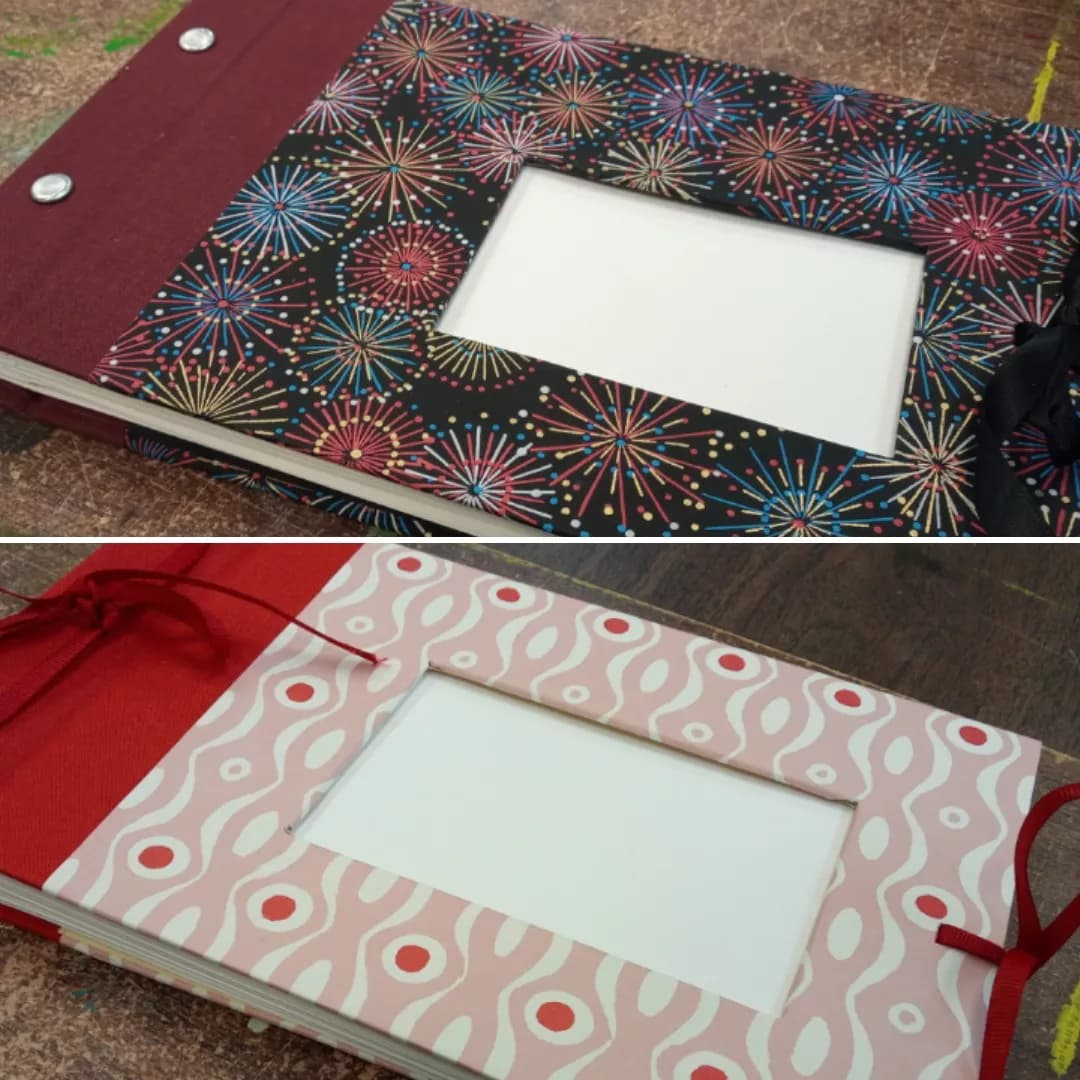
Most recently I taught a workshop about making albums, for photos or other things. The students made books that used standard post or ribbon bindings and then we added some pizzazz with windows, fore-edge ties, and even some corner embellishments here and there.
handmade album handmade album
Not long ago, I also taught another workshop where the students made bookcloth and then made a blank journal using the buttonhole binding technique. Everyone did a small practice journal with a paper cover, then used one of their prepared fabrics to make a hardcover journal.
handmade book handbound books
handmade journal handmade books
handmade books journals
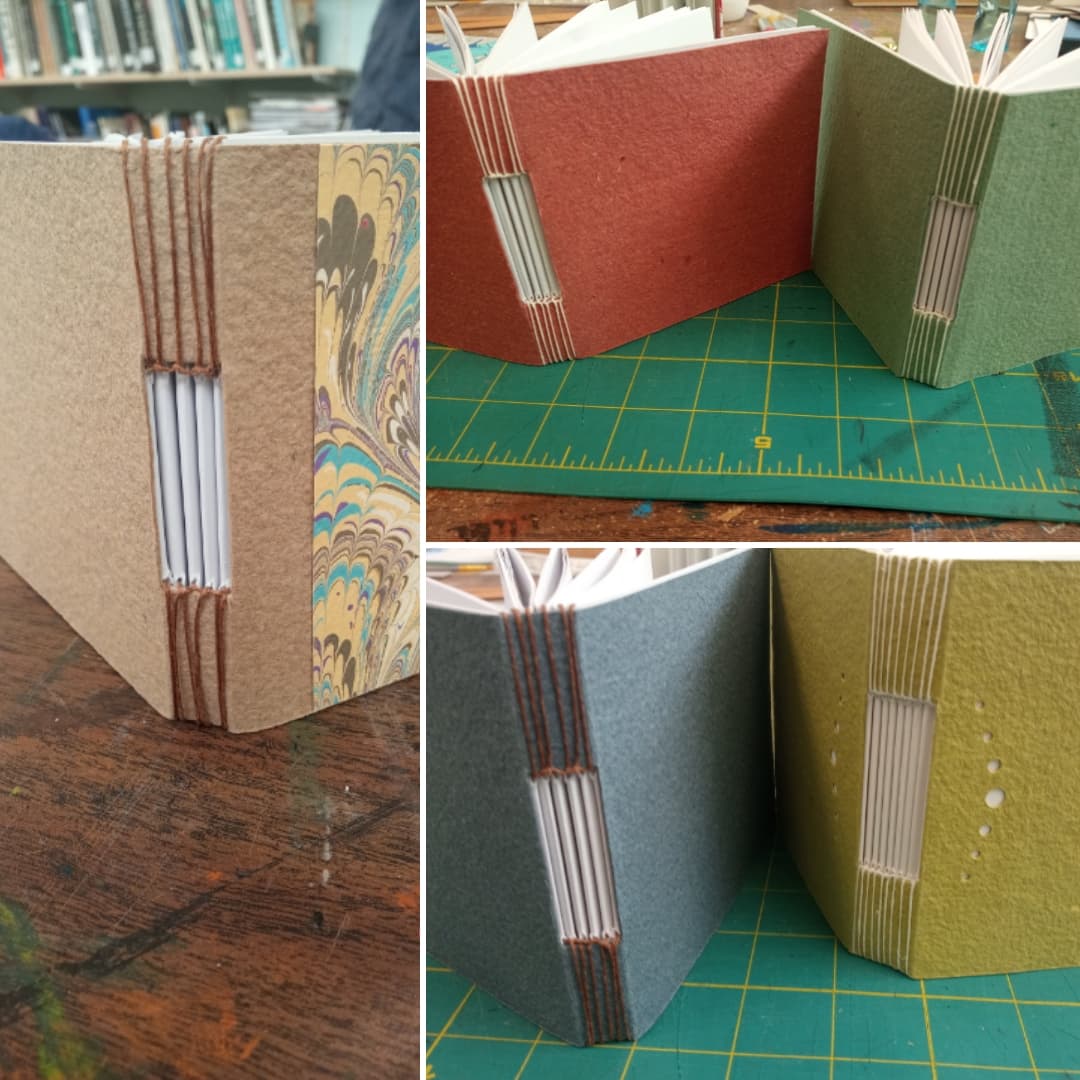
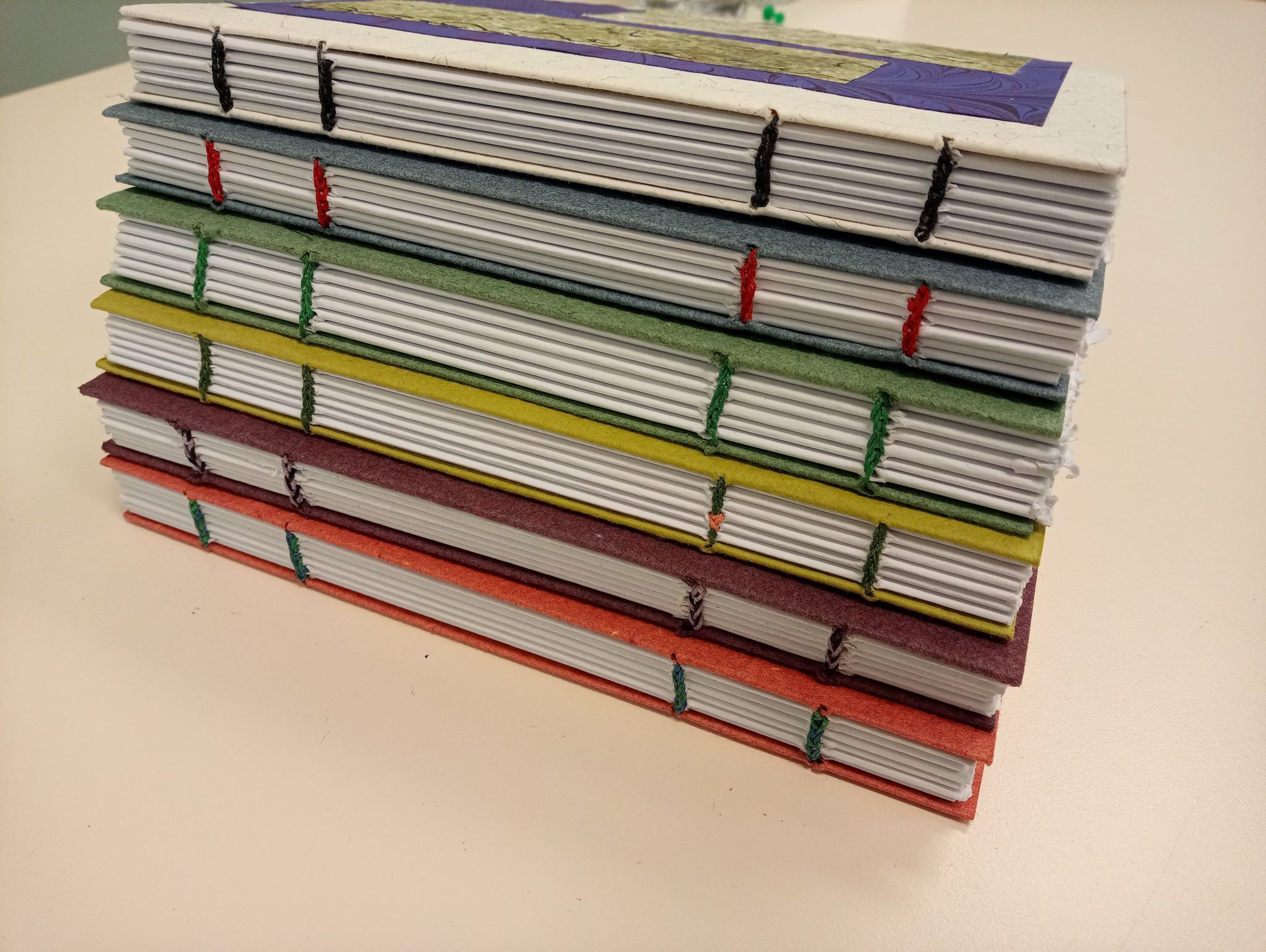
There was also a chain stitch workshop where everyone learned to make books with exposed chain stitch binding techniques. Different types of covers and cover attachments were explored.
handmade books
bookbinding
journals
Impressive work by everyone. I always seem to have the best students!
The spring session is coming soon now. Workshop links are in the right sidebar.

Monday, March 28, 2016

Book #363

Single Needle Coptic 2

I also found this alternate small 'C' coptic binding in Smith's Exposed Spine Sewings. It is rather different than other coptic-ish stitches that I have used and I really like it. The cover is made using a page from an old book, and it's a picture of a painting by Claude Lorrain. Particularly nice to do this friendly binding following yesterday's torturous book.

Tuesday, December 15, 2015

Book #286

Celtic Weave and Chain

I decided that I should try the Celtic weave again. This time, I combined one weave with four rows of chain stitches. The weave part worked better this time. I also like the stability of the chain stitches, so I think this combination is a better structure than the weave by itself.

Sunday, October 11, 2015

Book #276

Caterpillar + Chain

Today I have tried my hand at the Caterpillar binding, used in conjunction with a multi-needle chain stitch binding. This is the first time I have tried the caterpillar binding and this book also has the distinction of being the first book made in my new studio (which is one of the reasons that I slowed my blog-book-production, since moving into the new studio has been a gradual process and rather disruptive to my work flow).

Tuesday, July 21, 2015

Book #202

Single Needle Coptic 1

Today's book is an example of a single-needle chain stitch binidng, often referred to as a Coptic stitch. I included the multi-needle version of this ages ago (Book #3). The main difference in the appearance, is that the single-needle version requires a kettle stitch at the head and tail, whereas the multi-needle version does not. This little book has my suminagashi paper on the covers. I am not particularly happy with the cover attachment on this book -- I need to work on that.

Monday, July 20, 2015

Book #201

Icicle binding

For today, I made a book with the Icicle binding, which is from one of Smith's book (Vol 3). It feels like a stitch sampler. It has a kettle, a chain, a packed cord, and then also the elaborated packed cords with the extra dropped stitch and chain-like thing. With a good cover attachment, it feels very sturdy.

Friday, April 03, 2015

Book #93

Limp Vellum Chainstitch

This is another structure based on northern European medieval binding techniques. Parchment cover, reinforced spine, and a chain stitch sewing. Fore-edge envelope flap with a closure consisting of ties and wooden buttons.

Sunday, February 15, 2015

Book #46

Link & Longstitch Combo

This is a recently completed project, using a combination of link stitch and long stitch for the exposed binding.

Thursday, February 12, 2015

Book #43

Single Sheet Coptic
Single sheet coptic bindings are explored extensively by Keith Smith in his book Smith's book, "Sewing Single Sheets". My book shown here, called Knots, is an example of a coptic stitch sewn across the spine. The pages are made of book board so a single sheet sewing was needed. Knots includes diagrams for tying a variety of knots; rope is included for practicing.

Sunday, January 11, 2015

Book #11

Sewn Chains

This is an example of a pamphlet bound using a chain stitch. Keith Smith calls this binding sewn chains but it is really just a traditional embroidery chain stitch adapted as a single-section pamphlet binding.

Saturday, January 03, 2015

Book #3

Chain Stitch with Coptic Endbands
This is an example of a multi-needle chain stitch sewing, which I finished with Coptic-style endbands.

Friday, August 30, 2013

Link stitch, Long stitch, and Limp bindings at PBI

After having so many guest bloggers this summer, it is my turn now, to write about another one of the PBI classes. I absolutely loved this class taught by Adam Larsson. Partly because these book structures have been a particular interest of mine for several years and as such, I have actually made a lot of books like this and have tried to incorporate the techniques into a lot of my work. More importantly though, this would be the first time that I ever had instruction from an expert in this area, from someone who is working with actual historical examples of these books, from the 13th or 14th centuries that he has examined and studied first-hand.

My previous experience with this type of binding, was all based on tidbits of information here and there, scattered around the internet and overviews in a couple of books (Szirmai and Langwe). I have had to extrapolate a lot of the details about how the books were made, how the sewing was started, how the covers were folded, how the buttons and straps were attached, etc. I would often just try to replicate what I could see in photographs (example) without any detailed instructions.

The instructor for this class, Adam Larsson, has worked with these bindings enough that he was able to give me some insights about how these things were typically done. Adam works in the conservation lab at Uppsala University Library in Uppsala, Sweden, home to one of the most important collections of historic bindings in Scandinavia.

The class was called "The Three Ls: Limp - Link - Long" and that's exactly what it was. We learned three different methods of stitching a limp vellum binding, using just link stitch, using just long stitch, and using a combination of both.


The first book we did, was sewn with only link stitches. I think most people in the class found this one to be the most difficult of the structures that we covered. It is tricky to do this one, and I had only attempted it a couple times in the past. Having now seen how Adam does it, I may be willing to use this more in the future. Admittedly though, I haven't tried it again since the class. During the class, however, I did two books with this structure. The first was four rows of link stitches. The second was three rows of link stitches (which was harder than four!). The stitched circles are just decorative and were done on the spine before the book was bound.


After the link stitch book, we did the combination of link stitch and long stitch. This structure was most familiar to me, and I did three of this style during the class. The first one, I added the extra weaving on the long stitches. The second one, I added the decorative holes punched in the spine piece, and the third was made with soft leather (rather than vellum) and has the buttons on the spine rather than on the front of the book.


Adam demonstrated a third structure, which was a long stitch done without a link stitch. I don't think everyone tried this one, but I was a real keener, and surged ahead and made two of these. In fact, I really liked this structure. I had tried this technique only once before and I did it very differently that time. The way Adam explained it, it suddenly became far more attractive as an option for future work! These are the two that I made in the class, both with two spine pieces, one for each set of stitches.


Although we did most of our books without turn-ins, I did one with turn-ins and consequently made my first parchment tacket. I've made tackets with linen thread before, but making them from strips of vellum is much cooler. Starting with a long skinny strip of vellum, it has to be really wet, then twisted and stretched until it is dry. Then it is dampened again to make it pliable to create the tacket. As the tacket dries in place, it becomes a super solid attachment. This was certainly one of the highlights of my week!

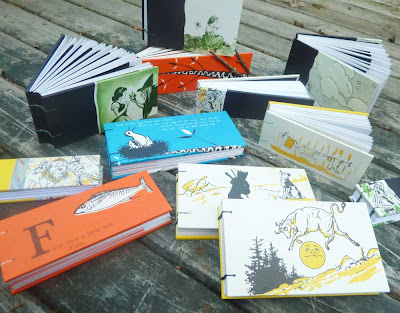
Although I had a lot of questions for Adam about the details of these bindings, the main thing that I learned, was that these historic bindings are greatly varied. The sewing techniques vary from one binder to the next; and, the use of spine plates and buttons and straps and decorative elements also vary from one binder to another and from one region to another, etc. So, there isn't one single correct way to construct these types of books and it is possible to be very creative with them. Other members of the class proved that over and over again. As I surged ahead trying to memorize the stitching techniques, other people in the class were creating masterpieces with decorative elements that I did not even attempt. Here are a few photographs taken at the end of the session where everyone's books were on display. The variations seen here are only a small sampling; the possibilities are truly endless.



Monday, August 05, 2013

Chalkboard Journals


Another great idea from me. Chalkboards on journal covers! And each one features some of my own hand-marbled paper too. I think these might serve as a perfect any-occasion book. The chalkboard area on the front cover can be changed as often as you like. Perfect for a cottage guestbook, where you can change the date or add a message for special events. Or keep it on the table in the front hallway, where you can jot quick reminders to the family as they are coming and going! It could be your bedside journal, for quick thoughts when you are half asleep - rewrite them inside the book, more coherently in the morning when you're fully awake! This book could also work as a sketchbook since it opens perfectly flat and has heavy paper inside. Write your daily inspirations on the front cover. Let me know in the comments if you have other suggestions for these journals.

Thursday, May 10, 2012

Old newspaper and birch bark

Just a couple of the fun journals that I had left over from last weekend's Halifax Crafters Spring market (which was a great time, by the way). First of all, an aged journal with an actual 1936 newspaper on the covers.
And this one, with real birch bark! Ever since the first time I used birch bark, I've been wanting to make books like this more often - the bark is a tricky material, but the result is very satisfying!
Both now available on Etsy.

Tuesday, September 27, 2011

Nursery Rhyme Books

I picked up an old book of nursery rhymes at a thrift store, a while ago, and the book was falling apart. It was quite a large hardcover book, but the hinges were broken and some of the pages were falling out. I got it because it was full of great pictures. I used several pages out of this book previously, but it is a big book! So I made more last week. So these are my newest recycled and repurposed notebooks, and each is entirely one-of-a-kind. The cover pictures, obviously, are repurposed from the old story book. The papers used for the pages in these notebooks, are off-cuts from other projects that I have saved. That's why they are all different, odd sizes and shapes. I was also able to salvage all the book board from my scrap box. They are all bound using a chain stitch sewing.

Friday, April 22, 2011

Happy Earth Day

So I've really blown my New Year's Resolution this month but let me get back on track today, celebrating Earth Day, with some journals I made using all recycled and repurposed materials. These are hardcovers, each with an exposed spine and chain stitch binding.


The paper for the pages in these journals is 100% recycled. The board used for the covers is all scrap board that would have been destined for land fill: chip board, eska board, and some pressed cardboard from the back of a large sketchbook. The decorative papers on the covers are pictures torn from magazines. Each cover image is created by combining two different pictures that were torn into strips. Click the photo to make it bigger if you want a better look at the images.

Wednesday, January 19, 2011

Brown paper bags

We use way too much of everything and throw away most of it. So I try to find a use for some of that stuff that normally gets tossed aside. One of the things I have been saving is paper bags.


I also save the board from the back of sketchbooks, so I combined that with the paper bags and made some little notebooks with a chain stitch binding.


They are a million miles from archival, I know that; but, they are just notebooks for scribbling grocery lists or other simple things and I don't think they need to outlive me!

Here's a shot of the spines - as requested!

Tuesday, October 05, 2010

Autumn Leaves

This is my Autumn Leaves / Autumn Memories journal that I made for the current TCET Challenge! That's a photo of my kid a couple years ago, buried in a pile of fallen leaves. Drop by the TCET blog to vote for your favorite handmade item. Also, if you have an idea that you think our team should use for our next challenge, leave a comment and we might pick your idea! Go here to vote: transcanadaetsyteam.blogspot.com

Saturday, July 10, 2010

A little history of the Chain Stitch

Early multi-section Coptic codices Dating from the 2nd century AD, the Copts used a chain stitch to bind multi-section books. In most documented cases, it seems that these books were sewn with a continuous thread and a single needle. The first and last sewing stations thus having half the number of loops as the other sewing stations. There are variations in the chain stitches from this period, though, since the technique was still in development. The cover would be made separately & attached after the textblock was sewn, covering the book completely including the spine. The textblock was attached by pasting it directly to the covers. Later Coptic codies After about the seventh century, there are very few extant Coptic bindings and most remnants are very badly damaged but it is evident that the chain stitch was still used. It also seems that the cover boards started being attached as part of the sewing process – unlike the separate attachment of the cover described above for the early Coptic codices. Ethiopian Codices Dating from about the sixteenth century, chain stitch binding had also evolved in Ethiopia. These books typically had paired sewing stations, sewn using two needles for each pair of sewing stations (so if there are 2 holes, use 2 needles…or 6 holes, 6 needles etc). The covers were wooden and attached by sewing through holes made into edge of the board. Most of these books were left uncovered without endbands. Byzantine bindings There were also Islamic bookbinding methods employing the link stitch, and Byzantine/Greek bookbinding methods using a link stitch. An interesting variation employed by the Greeks was sewing the sections in two groups, then joining them so the chains meet in the middle. This makes it look like the chain stitches change direction in the middle of the row. The Byzantine bindings are more likely to have elaborate endbands which are worked onto supports and anchored to the cover boards through holes in the boards. These books typically had full leather coverings. This quick summary is largely based on information in Szirmai’s text, The Archaeology of Medieval Bookbinding. There are five chapters dedicated to link stitch bindings so this is really a miniscule summary of what I read. There is some debate surrounding the various terms used to described the chain stitch binding methods that are so often used today, especially concerning the very loose application of the term "Coptic binding." Ekthesis has a nice article about the Coptic binding which includes some discussion of these issues. Photo courtesy of The Crafty Kitten Originally posted to the BEST Blog, Oct 2007

Thursday, April 29, 2010

Six journals

When I was preparing for the local craft market that I mentioned previously, I prepared the signatures and the covers for these six journals. I had the covers made, pressed, dried, and the signatures were folded and pressed and I took them with me to the sale to work on if there was any downtime. I got only two of them bound while I was there, each are sewn with four rows of chain stitches, or the small-c-coptic sewings. Now I've finished the others and added the buttons and ribbons.