Friday, May 10, 2013

It all starts this weekend

I am getting ready for another Paper and Book Intensive. I'll be on my way, traveling to Michigan this weekend and then I'll spend the following ten days doing some intensive paper and book learning! There is, as always, a very impressive cast of instructors this year. I'll be taking classes with Adam Larsson, Paula Jull, and Yas­meen Khan. It's all happening at Ox-Bow near Saugatuck. I'll post some updates over the next couple weeks, stay tuned!

Wednesday, May 01, 2013

Halifax Crafters Spring Market

If you are in (or near) Halifax this weekend, come visit me at the Halifax Crafters market!


Saturday, April 06, 2013

Make Your Own Leather Journal

In the past, I've offered a bookbinding kit for making a leather journal, which included all the materials and tools. After some requests, I decided to re-write the instructions so they can be used independently of the kit. So that's what I did.

This is a 9-page document, outlining the process for making leather journals like the ones shown in the photo. It's a soft-cover leather journal with a simple longstitch binding and a wrap-around cover and a strap. The document includes tips for selecting leather, detailed sewing instructions, and templates to cut out. Everything is fully illustrated with step-by-step instructions and written for people with no bookbinding experience.

The document will be sent to you by email, as a PDF file, as soon as possible after you purchase. (Please allow a few hours for me to get the notification and make the delivery). You can buy it in my Etsy shop.

No previous bookbinding experience is necessary but of course, you will have to provide the tools and materials. You will need the following tools: awl, needle, scissors, cutting mat, utility knife, and ruler. A bone folder is a good idea, but not critical. Also, you will need leather, paper, and thread.

Friday, March 29, 2013

Happy Easter

This has nothing to do with bookbinding, and I don't usually post about things that are so totally unrelated, but I'm making an egg-ception today. We dyed our Easter eggs using all-natural homemade dyes this year, and I wanted to document the process so that I can refer to it, and approve upon it, again next year.

Step One
Prepare the eggs. Either hard-boil the eggs, or blow them out. I did some of each. In the end, I like the blown out hollow eggs best. Although with a toddler here who is very interested in playing with the pretty eggs, the hard-boiled eggs are more durable, of course. After the eggs were boiled/blown, I also washed them with a little soapy water. I had read that eggs have some natural oils that might alter the effectiveness of the dyes, so washing with a little soapy water would remove it.

Step Two
Make the natural dyes.
1. Purple Cabbage: I put about a cup of chopped cabbage into two cups of boiling water and then simmered it for a half hour. When it was cooled, I put it though a strainer to remove the cabbage and was left with just the liquid. (It was very purple. I was expecting purple eggs, so I also used the purple cabbage dye, slightly altered, to make a blue dye. See "Blue Plan B" below.)
2. Onion Skins: I put about a cup of yellow onion skins into two cups of boiling water and let it simmer for a half hour. When it was cool, I put it through the strainer to remove the onion skins.
3. Turmeric: I put two tablespoons of turmeric powder into two cups of boiling water and let it simmer for a half hour. When it was cool, I put it through a mesh bag to strain it, and was able to remove most of the sediment to get a pretty clear yellow liquid.
4. Beet juice from a can of beets: I had saved some of the liquid from a can of beets for this, so I used it, just as it was. I didn't boil it. But I probably should have. (I got a couple very pretty pink eggs from using this beet juice but within 24 hours, they started to turn brown and looked terrible. So I don't recommend this for dying your eggs. Boiling chopped beets to make a pink dye might be a better approach since I read about other people using beets with no complaints).
5. Spinach Juice: I had some spinach juice so I thought I'd try it to make some green eggs. I boiled it, and noticed that the water turned brown. I discarded this brown water since I didn't want to make brown eggs - I can get pretty brown eggs at the store! So, I tried using some of the raw spinach juice, but it didn't work. See "Green Plan B" note below.

Step Three
After the dyes are cool, put them into containers, such as a glass measuring cup or a jar, and add about two tablespoons of white vinegar to each container.

Step Four
Submerge the eggs in the dyes. I kept the containers in the refrigerator although I don't know if that really matters. I checked on them periodically, and found that most of the colours started to work after about a half hour. The photo just above, shows how they looked after about an hour. Look at that pretty pink! The longer they were submerged, the darker the colours became. I took out some eggs after just a couple hours and I left some for about six hours so I got different shades of each colour.

Step Five
When you are happy with the colour of the eggs, remove them from the dyes and let them dry. That's it. All done!

And go ahead, pour your leftover dyes down the drain. All natural. No harm.

A very pretty batch of Easter eggs, don't you think? In this next picture you can see what is happening to the pink egg. It started to get blotchy, then turned brown, and I threw it out yesterday when I saw that it had turned grey. I had made two pink eggs, and the same thing happened to both. Next year, I will perfect the pink egg.


Blue Plan B
I wanted to have some blue eggs. So, something from somewhere in the back of my mind, was telling me that if I added baking soda and vinegar to the purple cabbage dye, that it would turn blue. And it did! So in the photo above, the "Blue Plan B" is actually purple cabbage dye with vinegar and baking soda. If you try this, make sure you have lots of room in the container because it really fizzes up when you add the baking soda! In the end, the original purple cabbage dye (without the baking soda) also resulted in blue eggs. I thought they would be purple, but they are the darkest blues shown in the pictures here. The teal blues are the ones made with the altered purple cabbage dye.

Green Plan B
The raw spinach juice didn't work at all. After a couple hours, the eggs were still white, so I discarded the spinach juice and put "Green Plan B" into action. I had blue dye. I had yellow dye. Shouldn't I be able to combine them and get green dye? So, I made some more purple cabbage dye, added the baking soda and vinegar and got a new little batch of blue dye. I also boiled some more turmeric and got a new little batch of yellow dye. Then I mixed them together and got green! I didn't cook them as long because I was rushing a bit, so the dye was pale and consequently the eggs were also pale. But I think if I had made a more concentrated dye, I could have got brighter or darker green eggs. I will try again next year.

Perhaps someday I can connect this with a bookbinding project. I'd just have to make natural dyes for book cloth... I think the process would be very similar. Happy Easter, anyway!

Wednesday, March 27, 2013

Making Journals with repurposed materials

A while ago, I conducted a workshop at Inkwell, where we made journals entirely from recycled materials. Let me introduce, the Secret Scottish Rubbish Binding. I learned this book structure from Emma Fraser, a conservator and bookbinder, in Scotland. She invented this neat little book structure and always made it with box board for the covers, discarded papers and envelopes for the pages, and it is actually bound together with a plastic bag, all rubbish, hence its name.

Here's an example of a Secret Scottish Rubbish Binding, that I had brought to show the participants before we started.

Participants were asked to bring their own box board to the class, so there was a good variety of cover materials: cereal boxes, tissue boxes, shipping boxes, etc. We used a variety of discarded papers for the pages, and colourful plastic bags for sewing. Here I am, demonstrating the "sewing" process using a plastic bag.

Here is some of the work in progress. There does seem to be a lot of rubbish scattered around on the tables!

Finished books, and a shot of some spines so you can see how the plastic bag looks.

I also took this little sample with me. This is the same book structure, but it's made from new materials, no rubbish included. I wanted to show the workshop participants that they could use the technique this way as well and it looks pretty, but I honestly like the rubbish books better.

One of the people who attended this workshop, very kindly took some time to write up instructions for making this and she posted them on her blog along with pictures. Check it out at PebblesandButtons.com. If you try it, I hope you come back and tell us about it!

Saturday, March 23, 2013

Barn Owl Notebooks

I like carving linoleum and rubber stamps even though I don't seem to have much time for it. Last week, though, I found time to make this Barn Owl stamp to use on notebook covers.


I also did some Snowy Owl sketches and may try him next. But for now, if you're in the Halifax area, these small Barn Owl notebooks are now available at Inkwell Boutique.

Thursday, March 21, 2013

Congratulations to the Weekly Planner winners!

Today I randomly selected the winners for the two weekly planners that I am giving away (see pictures here). There were a total of 67 entries, combined from here on my blog and from my Facebook page. I numbered all the entries, starting with the blog comments (1 to 53) and then the Facebook comments (54 to 67). Then I used the random number generator at random.org to pick a number from 1 to 67.

The first number it selected was 62. That means, commenter #62, Dar Miller, wins the brown leather weekly planner!

The second number it selected was 11. So commenter #11, Katy The Country Blossom, wins the purple weekly planner!

Congratulations Dar and Katy! I hope the rest of 2013 is wonderfully organized as a result.

Sunday, March 17, 2013

Happy St Patty's Day

Since it's Saint Patrick's Day, I did a little nostalgic browsing through my photos for green things! Here are a few that popped out:
In fact, I seem to have lots of green things. If you want to see more, visit my flickr pool, using the label "green" at www.flickr.com/photos/myhandboundbooks/tags/green and have a fun day today doing Irish things (or not)!

Tuesday, March 05, 2013

2013 Weekly Planner Giveaway

I have two 2013 Weekly Planners to giveaway! All you have to do is leave a comment here and tell me how much you want it. Or tell me how it will help you get organized for the rest of the year. Just tell me whatever you want to tell me, really. If you want to get extra entries, you can tweet (include @myhandboundbook) or share on your own blog (and leave a link)! Comment here to tell me you've done those things. Be sure that your comments include an email address or something that will allow me to contact you if you win.

So, as I said, I have two planners to giveaway.

First one. This planner is my standard leather weekly planner, with a camel-brown wrap-around cover and a strap. In addition to the standard 2013 calendar pages, there are lots of extra blank pages, a pocket page, and there is a ribbon bookmark too. Value $30.


Second one. This is a simple, slim, purple planner with a cover made from gorgeous St Armand handmade paper. It's a sturdy cover and it has a little pocket built into the back cover where you can store a pen or some business cards or whatever fits in there. The front cover is stamped with my original 2013 rubber stamp. Value $10.


I will accept entries here on my blog, and on my Facebook page, until the end of the day on March 20th. Then I'll number all the entries according to the order they are received, and use a random number generator to pick two winners. The first number drawn will win the brown leather planner. The second number drawn will win the purple planner. I will ship them anywhere in the world. So leave a comment and cross your fingers!

Sunday, February 24, 2013

Book Review: Beautiful Bookbindings

Beautiful Bookbindings: A Thousand Years of the Bookbinder's Art
PJM Marks
The British Library and Oak Knoll Press, 2011

This is, as the title indicates, a collection of beautiful books from a very long tradition of bookbinding. The earliest book included is from the seventh century, and from there the collection continues along an ambitious timeline, finally reaching the early days of the twenty-first century in the last few pages.

The early books displayed in the first chapter, span about ten centuries so the result is a very brief snapshot of a very long period of history (exhibited over a mere 11 pages). The selections from this period are, indeed, beautiful and show primarily those books which fall into the Western tradition of bookbinding. There are some exceptions to this, with an example of a concertina from Korea (14th C) and an Indian pothi (15th C), like a palm-leaf structure.

The early books are my personal favourites, so I would prefer to see more in this chapter. The next five centuries each get their own chapter, starting with the Sixteenth Century and ending with the Twentieth Century. Each of these chapters has about 30 pages, thus permitting a better overall view of each period compared to the first chapter. Of course, there are far more books surviving from these recent centuries so it is understandable that they would be represented here in greater numbers.

Beauty, of course, is in the eye of the beholder and it must have been very difficult to choose which bindings to include in this book; but, I think the selections are very well made and illustrate the various bookbinding traditions (albeit primarily Western traditions) very nicely. It would be even better to see more books from outside the Western tradition, but I do understand that any collection like this must have boundaries and cannot include everything. The collection is mostly codex format bindings in the English and German traditions with a sprinkle of Asian here and little American there. The collection focuses on the cover decorations used by bookbinders, not the actual binding structures. There is lots of tooling and painting and embroidering and inlaying. As it mentions in the text, the artists (i.e. the bookbinders) behind these amazing works of art, are mostly unknown and individual bookbinders were rarely credited.

The photographs in this book are flawless and there are many close-ups showing amazing details of painting and tooling and texture that can be very difficult to convey on smooth glossy paper. Wonderful detail is shown in a photo of a fabric-covered book (p. 53) where the weave of worn velvet can be seen, almost felt, beautifully intact on the face of the cover, slightly frayed in the hinge area by the spine - complete with a little stain here and there - and embellished with ornate clasps and painted metalwork.

Attention is also given to certain details such as clasps and fore-edge decoration. Various books with exceptional fore-edge decoration are examined in almost every chapter. This is a lovely detail to highlight in a book like this and it is fascinating to see it evolve over the centuries. Chapter 3 (Seventeenth Century), has several stunning examples of fore-edge clasps - another lovely detail on which to focus. Most of the examples are metal clasps, but there is also one example of an embroidered binding made for James II, which has fabric ties rather than metal clasps. As the collection moves forward in time, it is delightful to see how all these ornate bindings influence the trade bindings of the nineteenth century. There are several gorgeous examples of trade bindings in this book, mostly from London, showing the very pretty, colourful covers of the popular literature at the time.

I have enjoyed browsing and reading this book and admiring all the fabulous tomes presented therein. The selections in this collection are all beautiful, certainly, and I suspect that this is a good representation of the entire collection available at the British Library. The final chapter on Twentieth Century bindings showcases a few of the best design bindings of the past hundred years, all very traditional in spite of the experimentation that has been happening in the book arts in recent times; however, another hundred years (or so) must pass before someone can choose the bindings that best represent the current century.

Reviewed by Rhonda Miller, Feb 2013.

Friday, February 01, 2013

Last of the 2013 Weekly Planners are now 50% Off

Once February arrives, I figure it's time to let the rest of the Weekly Planners go for half price. So if you were waiting for this moment to come, or if you were just procrastinating about getting yourself a new agenda, then the time is now!

They are half price until they're gone!

Check my shop to see available colours:
www.etsy.com/shop/MyHandboundBooks

Tuesday, January 22, 2013

The little books, repaired

Last month, I mentioned that I had been asked to repair a set of old books, and then I left everyone hanging, wondering what had become of them! Well, I finished them before the holidays, and now I'll finally tell you more about it.

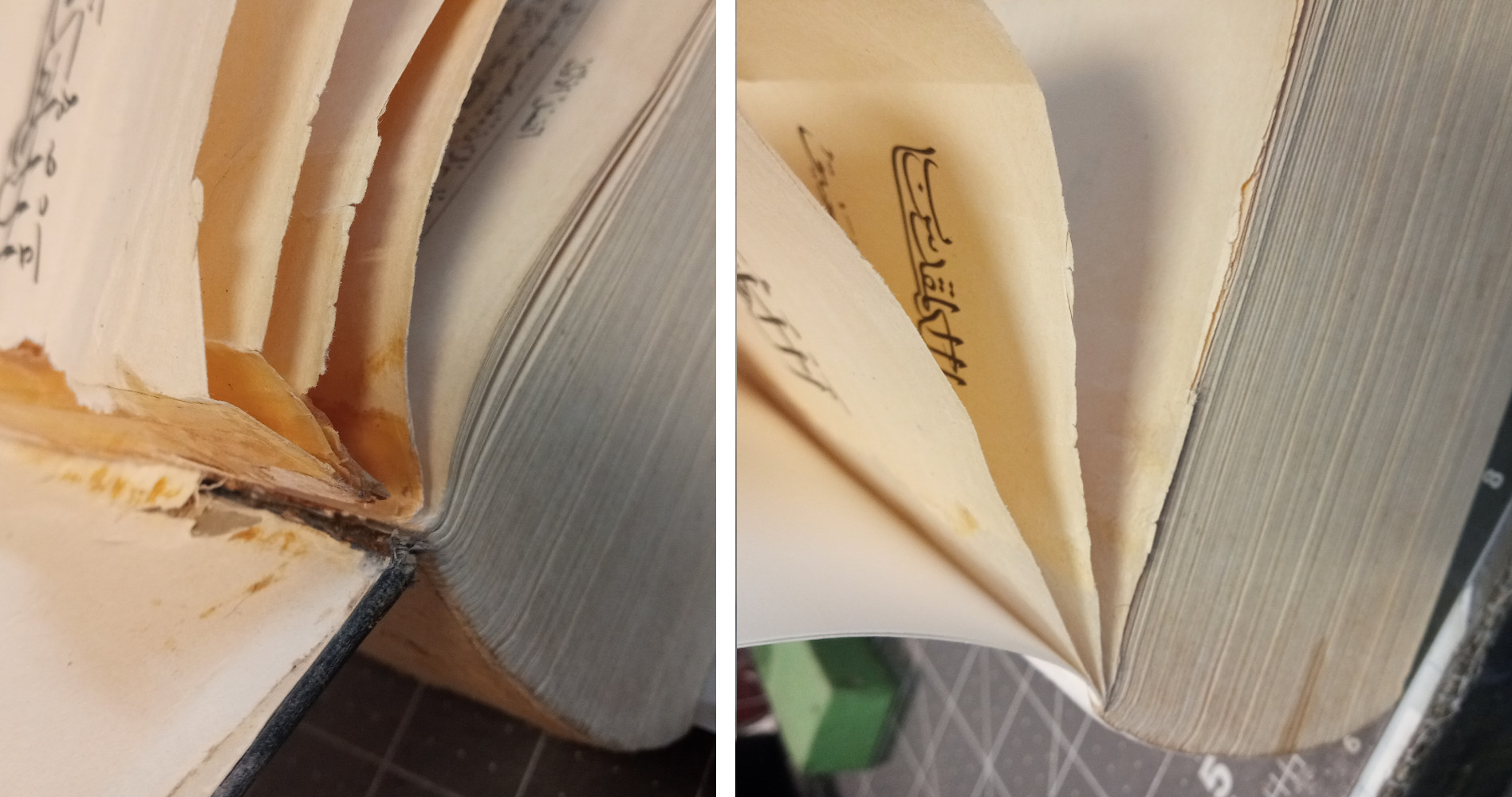
It was a thirteen-volume set of Shakespeare's work, called the Handy Volume Shakespeare. The books were very small, thin paper, etc. As can be gleaned from a little online research, it seems there must have been many, many of these sets produced over a period of a few years around the turn of the century (although this edition was undated so I don't know exactly when it was printed). This particular set must have been very well used since the spines were badly cracked or missing, some band-aid repairs had been done in the past, and the covers were just disintegrating in my hands when I tried to work with them.

The main objective of this project was to make new covers for the books, and make the set functional once again.

As I said, there had been some attempts at repair and I found some of the covers stuck on with cellophane tape (gasp!), and there were a few loose pages that were taped as well.

I even found one page taped, and reinforced, with reinforcements!

It was an interesting adventure to poke through each little book. There were some random surprises, like little notes, a bit of ribbon, some other little inclusions, a bit of marginalia, etc.

After the covers were removed, I cleaned the gunk and old cover material off the spines. I used wheat paste to soften the old glue and cleaned them as well as I could.

As it turns out, the bindings were very much intact and I didn't have to resew any of them (thank goodness). This is how they looked after that messy spine cleaning part was finished.

Before I started working on the new covers, there were a few loose sheets that I had to tip in. A couple of those pages needed to have holes filled, like this one, where I added paper to the corner area before tipping it in.

So, surprisingly (or maybe not), making and attaching the new covers turned out to be the easiest part of this project. We decided to go with brown leather and paper spine labels, in an attempt at keeping their appearance in line with their age - and this is how they looked when I was done:
They were successfully finished and delivered before the holidays to be given to some lucky theatre student as a Christmas present. Hopefully they will be well used for another hundred years.

Additional photos that were taken for this project can be seen in an album on my Facebook page if you're interested: www.facebook.com

Wednesday, January 02, 2013

Happy New Year!

Welcome 2013! I'm really looking forward to this new year. I have lots of bookish plans and ambitions and can't wait to get started.

Just to start things off, you can stop by my Etsy shop for 23% off, just by using the coupon code: HAPPYNEWYEAR when you order. A perfect opportunity to get a great price on your new journal or weekly planner! Visit www.etsy.com/shop/MyHandboundBooks and order before midnight Jan 3rd, to take advantage of this coupon code. Happy New Year everyone!

Monday, December 24, 2012

Merry Christmas!


Merry Christmas to all my blog readers! I hope your holiday is filled with books - books in any form. Like previous years, I had a little Christmas bookmaking project recently. This time, I made little books as tree decorations.


The covers have various Japanese papers, and some of my marbled paper. Inside, they each have a few bars of Jingle Bells printed on the pages.


Previous Christmas book projects: 2007, 2008, 2009, 2010, 2011
Merry Christmas!

Thursday, December 13, 2012

Repairing some little books

This is what I started with last week. It's a set of 13 small books. Old, falling apart, dirty, uggh. The project is now well underway. They will have new covers and look fabulous in a few days!