Showing posts with label single sheets. Show all posts

Monday, February 08, 2016

Book #324

Raised Cords for Single Sheets

There are times when it is necessary to bind a stack of sheets, rather than signatures. Keith Smith wrote a book about that too - Sewing Single Sheets, which is Vol 4 in his series of books about non-adhesive bindings. That's where I learned this particular binding, which is sewn on raised cords. When I was making the cover, I knew this was going to be Book #324, so I let that fall on there just for fun.

Wednesday, August 19, 2015

Book #231

Saw Kerf Binding

This method is suitable for binding single sheets or rebinding books. I used it to rebind one of my favorite books, of which my only copy was a tattered perfect-bound paperback. Now it looks much cooler redressed in its hardcover suit and Ann Muir marbled paper.

There are instructions for this saw kerf binding in Pauline Johnson's book, "Creative Bookbinding" (which has a few useful bookbinding tidbits but is mostly just a wonderful 1960s time-capsule).

Monday, August 10, 2015

Book #222

German Paper Binding 2

Today's book is another German Paper Binding. This one is an adhesive bound structure with a cloth spine and paper-covered boards, trimmed flush at the head and tail. I was reading about this on Peter Verheyen's blog and he wrote that it works well as a binding method for documents printed on stacks of loose sheets, so that is what I did here. And he is right, it did work very well.

Thursday, February 12, 2015

Book #43

Single Sheet Coptic
Single sheet coptic bindings are explored extensively by Keith Smith in his book Smith's book, "Sewing Single Sheets". My book shown here, called Knots, is an example of a coptic stitch sewn across the spine. The pages are made of book board so a single sheet sewing was needed. Knots includes diagrams for tying a variety of knots; rope is included for practicing.

Saturday, April 11, 2009

Recycling again

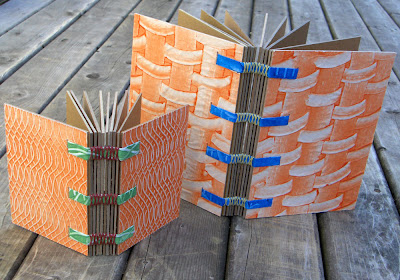
Books made from cardboard. Yeah, the purist bookbinders will cringe. These aren't exactly archival. They are just fun notebooks - not everything needs to last forever.


You see, for a lot of my handmade journals, I use paper from large sketchpads for the pages. Each time I finish with one of these sketchpads, I'm left with the large cardboard sheet from the back. So once I accumulate a stack of them, I cut them up and turn them into these cardboard books. It makes sense to me.


I have found that paste papers look great on these. My paste papers are obviously really basic, nothing fancy, and so I think they suit these books rather well. Making cardboard books gives me an excuse to make paste papers.


These are bound using one of the stitching techniques described by Smith in his book Sewing Single Sheets. There are folded strips of paste paper used as sewing supports, and sewing creates small Xs along the spine.

My stack of cardboard was almost to the ceiling when I started on these so I have lots of them.

Sunday, September 14, 2008

Corrugated Cardboard


Once you leave the realm of archival materials behind you, there is no going back. When I first started making books, I never strayed from archival materials. Gradually, though, I have come to believe that not all books need to be (or should be) archival.

I've heard a bit about a movement in the art world to produce temporary art with the understanding that its existence is transient, temporary, and immediate; it does not need to be preserved; we simply cannot preserve everything, we do not have the means or the space to do so; so just enjoy it now and allow other works of art to take its place when the time comes. In this same spirit, I do not think it is reasonable to expect all books to be preserved and certainly many little notebooks and scribblers just don't need to last hundreds of years...how many little notebooks full of "to do" lists will be of interest to our future generations?

So, these are tremendously non-archival books (which are also not works of art, they are just silly little books that might be fun to use for grocery lists or such things).


Each is made using 10 sheets of cardboard; a mixture of corrugated cardboard, pressed board from sketchbook covers, scraps of Eska board and mat board, etc. I'm not sure what the life span is for acidic corrugated cardboard... 10 years maybe before it begins to deteriorate? There are some varieties of corrugated cardboard that are archival, but I have not made any attempt to find archival materials for these books. All the cardboard used in these books was cut from boxes and boards that were lying around my workspace. The Eska board and mat board sheets were archival, but after lying next to acidic cardboard, they are not archival any more.

I used some of my paste papers to decorate the covers and also used folded strips of contrasting paste papers to make the sewing supports. The books are bound using a technique from Smith's book, "Sewing Single Sheets." It looks nice, creating little Xs on the spine like this:


Also, the books open completely flat with minimal sewing visible on the inside, just a neat pattern like this:


At times, I still like to get serious and do things 'by the book' and use entirely archival materials - but there is lots of room for these more temporary books. Maybe I will just stamp a little message inside, indicating that the book might self destruct in ten years!