Wednesday, August 31, 2011

Gramma's Things


While going through my late Grandmother's things, my mother found a lot of handiwork that Gramma had done, or partially done. After hearing about 23 Sandy Gallery's recent Uncommon Threads call, I used one of Gramma's unfinished crocheted pieces to make this book (although it isn't part of the exhibit, it was that call for entries that prompted me to it).

The 'pages' of my book are made of book board, covered with the pages of one of her old Crochet & Tatting pattern books. I added a little narrative to the pages about my grandmother's things.

As you can see from these next two photos, the book structure allows it to open like a standard codex, or as an accordion.


It can be opened both ways because it is constructed like the old Jacob's Ladder toys. I even made a little video here to show the fun part, how it can be an endless ladder even though it consists of only six panels, er, pages.

Sunday, August 28, 2011

Marbling Larger Papers

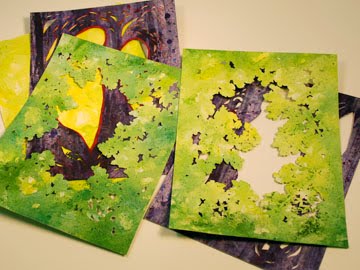
Until recently, I was only marbling small sheets of paper, about 9x12. People often asked if I could do larger sheets but my equipment prevented me from going bigger. Last time I was marbling, though, I found a container that I could use to try some larger sheets. I ruined several sheets immediately - switching from laying down a 9x12 piece of paper, to a 16x24 piece of paper, was not an instant transition! Suddenly it felt like I'd never done it before and I had to learn the technique all over again. After some practice, though, I did successfully produce several large sheets. These images are scans of the larger sheets - the scans show only a 9x12 area, though, since that's the size of my scanner bed.

Friday, August 26, 2011

flickr friday - RED

Another Friday, and about 85 pictures tagged with RED. Apparently it's a popular colour in my work! I do like red, actually, and this selection includes many shades of red - since, sometimes burgundy is red...etc. Follow the RED link to see them all. Or, here are a few of them, randomly selected using the Flickr badge tool:


Wednesday, August 24, 2011

Secret Belgian Binding -> Criss Cross Binding

As I mentioned a couple months ago, it is now known that the 'Secret Belgian binding' was invented by Anne Goy in the 1980s. It is not an obscure historical binding as many people thought. I had a little note directly from Anne after I posted here, and she says that she wants this binding to be called "Criss Cross binding" -- rather than the secret Belgian Binding. It's going to be hard to convince people to change their name for this structure, I think, but I wanted to share that information so that we can at least make an effort to call it by its proper name!

Anne Goy's Website: www.annegoy.be.

Friday, August 19, 2011

flickr friday - YELLOW

I like using the tags on Flickr. It's a great way to categorize and it's a very librarian-type-thing to do. There are about 57 photos in my Flickr photo pool right now, that I have tagged with YELLOW. Follow the YELLOW link to see them all. Or, here are a few of them, randomly selected using the Flickr badge tool:


Friday, August 12, 2011

Guest Blogger Fran Kovac, on 6th Century Coptic Binding

Fran Kovac is a bookbinder in Columbus, Ohio, and teaches basic bookbinding techniques at the Morgan Conservatory in Cleveland, Ohio. She is ridiculously camera-shy, but has allowed me to to use a picture of her fingers sewing a link-stitch endband, very much like the endband for the Coptic structure she describes here.

I first encountered Fran's work, way back in 2006, when we were both participating in a book swap through Volcano Arts. I think she ended up with the first book that I sent. Later I acquired a couple of her marvelous books through the swap. In 2008, I attended PBI for the first time and was chatting with her when suddenly I realized it was the same person, Fran Kovac! She's been at PBI every time that I've been there - and now she's kindly agreed to write about one of her 2011 PBI classes for my blog. Thanks so much, Fran!

While Rhonda was slaving away in John Townsend's Extreme Bookbinding (see her post, below), I was spending the week with a Late 6th Century Coptic structure taught by conservator and book historian Julia Miller. This is an exquisite structure that is a recreation of an extant manuscript known as "Chester Beatty Ms. 815" but also called "Codex C." The original has a parchment textblock sewn with a link stitch at three sewing stations, on papyrus boards. The book is leather covered with an inked design, with a wide wrapping band held with a bone clasp and an attached bookmark.


We began by making our papyrus boards. Pasteboard is simply a board made by laminating sheets of paper or papyrus together. Julia pointed out that there is evidence that boards were often made with fragments, scraps, inscribed sheets and bits of leather and vellum, pressed together, and in fact, we made samples with scraps left over from class. Codex C had papyrus boards, though, so for our books, we laminated papyrus until we had boards approximately 5 mm (~3/16") thick.

We used paper for our textblock, alas, parchment being rather expensive. I added one parchment end sheet to my model for the most verisimilitude I could afford. We folded and marked our textblocks for sewing. This link stitch is recessed in the original, so we carefully cut notches in our textblock to accept the thread. The sewing is rather different than that which is usually taught today: three stations, single needle, with the thread doubled inside each signature. A note about "Coptic" sewing: historically, not all link sewn books are Coptic in origin. We commonly use the terms interchangeably, but unless what's being talked about is an actual Coptic binding, such as Codex C, we should probably use the term "unsupported link stitch."

After sewing, we added link stitch end bands in colored thread, and lined the spine with linen. We made and decorated our bookmarks, wrapping band and bone clasp. The original clasp is vaguely fish shaped, with a single hole for the strap, and is undecorated except for some scratches. We used cold tooling and ink to decorate the bookmark and ink designs on the wrapping band.

We had lovely goatskin to work with to form the case with the papyrus boards. Goat, sheep, and other hides such as camel are believed to have been used in history. This is, essentially, a very early (the earliest?) case binding; the boards are not sewn to the textblock. The boards and leather were laid out pretty much as we would do today when making a case, although with extra wide turn-ins.

Inside front board showing the wrapping band attachment

The end sheets are pasted down to hold the textblock in place. Prior to putting in the textblock, however, holes are punched through the front board to accept the wrapping band and bookmark, and the tricky work of drawing the inked design began. The model of Codex C which was made shortly after its discovery served as our model for the design; it incorporated a Maltese cross, which seemed the wrong time period to me, so I incorporated a Coptic cross in its place.

My thanks to the extraordinary Julia Miller for another wonderful historic bookbinding class, and to Rhonda for the chance to talk about it!

Wednesday, August 10, 2011

Saturday, August 06, 2011

When Marbling Washes Away

When marbling, after a sheet of paper has been laid on the floating paint and lifted from the tank, it has to be rinsed with water to remove the excess size. Sometimes the paint on a sheet of newly marbled paper just washes down the drain. This happens when the paper isn't suitable for marbling. During my last marbling session, I tried some different paper and it became a good example of what happens when the pattern just washes off. Once I realized what was happening, I got the camera a made a little video to show you. Much effort, washed away in 20 seconds.


It's disheartening when this happens! Well, I won't try marbling on this paper again.

Wednesday, August 03, 2011

Guest Blogger Charles Wisseman, on Moku Hanga and Martin Vinaver

Charles Wisseman is a retired pathologist who now does mixed media art with a current emphasis on book arts and papermaking. Charles lives in Champaign, Illinois and has a website where he shares some of his work: www.charleswisseman.com.

Charlie has been at PBI every time that I have been there and I think he's been there many times more. This year at Ox Bow, he took Martin Vinaver's class on Moku Hanga, a Japanese woodblock printing technique. He kindly agreed to share his class experience here on my blog.

Martin Vinaver was an unusual presence at PBI this year ( May in Oxbow in Saugatuck, Michigan). He is a Mexican from Vera Cruz who fell in love with Japanese woodblock printing, which led him to learn Japanese and spend several years in Japan learning this art form from remaining masters. This is a difficult and labor-intensive process which is in decline. The samples of older prints from Japan show an almost superhuman degree of fine detail and carefully drawn lines.

On returning to Mexico, he set about working with some other Mexicans and foreign artists to try to "Mexicanize" the process, because some of the Japanese materials were very expensive or unobtainable in Mexico. He gave a talk on his art center progress so far, with U-tube clips showing the making of paper from old towels discarded by local tourist hotels, lithograph stones from local quarries, locally cast metal parts for presses, local colored earths for pigments, carbon black from the local bakery, fat for lithography crayons from local sheep, etc. The website for his organization is www.laceibagrafica.org.

In the class we did not try to reach the level of the old masters. Each person tried to carve and print an original 4.5" x 6.5" block of shina plywood to learn the traditional methods of carving (including registration points), mixing pigments and printing on Japanese paper using a traditional baren. Martin brought carving sets of traditional style made locally in Mexico using steel from older quality European files. These were for sale after the class, and I liked the tools enough to buy a set. He brought powdered earthen pigments from Mexico, demonstrated traditional baren-making (which we all tried).

We were all feeling pretty good about our designs and carving, until Martin came in on the third day and said that we needed to carve our negative spaces deeper to avoid stray ink transfer. In the cold studio space this was not welcome news, but the final results were worth it. I carved a turtle design using two blocks.

Moku Hanka Woodblock Print by Charles Wisseman


Carving to have color areas contact without gaps or overlaps was harder than I expected, but we were all pleased with the results. The main challenge is to think in terms of color areas rather than lines. I have no graphic training, but found the final result pleasing.

Martin's other contribution was tai chi instruction in the open before breakfast every day. I liked his style better than other forms I have tried, but probably can't find a teacher here. What a great way to start the day, though.


Martin Vinaver leading tai chi at Ox Bow


Tuesday, July 26, 2011

Green

Each year there is an exhibit of artists' books at Cuesta College in San Luis Obispo, California. This year's exhibit, "Artist's Books 2011," is happening now, continuing until August 26th. Included in this exhibit is a little green book that I made. It is a small book, an edition of 7, bound using a dowel-spine structure with all materials being recycled, reclaimed, repurposed, etc. The content is also green.


This little book recognizes the achievement of Canada's Green Party, successfully electing Elizabeth May, the first Green member of parliament, earlier this year. The pocket on the inside of the front cover includes a business card (from my local Green Party candidate, Thomas Trappenberg) that lists the principles of the Green Party. The remaining content recognizes the Green Party's acheivements and also questions why green principles are not already part of other political agendas.

Saturday, July 23, 2011

Using leather for patchwork

It starts as a pile of leather pieces. I sort it and match it and plan out the pattern. Then I sew them together to make covers for journals. Finished covers... Finished journals...

Monday, July 18, 2011

Witherstone Gallery, Lunenburg, NS

Earlier this year, a new gallery opened in Lunenburg, NS, called Witherstone Gallery. Artist, Shawn Orne, conceived and established this gallery to showcase local artisans. Shawn has created a beautiful space in the heart of Lunenburg's unofficial art district, on Lincoln Street. This little part of Lunenburg has several galleries and art studios clustered together so it's a great spot to visit if you are in the area.

There is an amazing group of artists showcased at Witherstone. Alongside local artists such as Shelagh Duffett, Daina D. Scarola, Marina Smith, Sarah Morton, Sharon Hodgson, Mike and Sherry Goede, Julia Williamson, Shawn Orne, and more, I am thrilled to have my work on display here (part of the display shown here on the right). The next photo (below) shows another angle in the gallery where you can see the work of some of the artists mentioned previously.


Recently there was a Street Festival and Artwalk in Lunenburg so I was there with my work, set up on the sidewalk outside Witherstone Gallery. I was making books and had some work on display. Set up beside me was another one of Witherstone's artists, Anouk. She is here (photo below, in the pink) with several of her amazing paintings displayed on the sidewalk near the gallery. Anouk's work is amazing, you can see more on her blog at anoukwolse.blogspot.com.

Friday, July 15, 2011

Guest Blogger Lexi Janezic, Letterpress

Lexi Janezic is a mixed media artist (drawing, painting, collage) and prospective book artist living in Kansas City, Missouri. We met this year at Paper and Book Intensive, where Lexi was attending as one of the Nell Meldahl scholarship winners. You can visit Lexi's blog at thegreywoman.tumblr.com.

As part of my continuing efforts to tell everyone about all the PBI classes, even the ones that I didn't take, Lexi agreed to tell us about the Letterpress class that she did with Jean Buescher Bartlett.

I started PBI 2011 having no knowledge of what to expect from this pleasantly unique event. The idea of having workshops strictly devoted to the art book and paper was as foreign to me as astrophysics. For the past year I have lived in a world where I felt I needed to be either an artist or a conservator, it was strange to think that I would be able to meet people that defined what it is to straddle the line between these two very different paths so seamlessly. It was a tremendous relief from my conscience as a creative individual, who had initially felt that it was impossible to find a happy medium between the two worlds.

From talking amongst my fellow PBIers, it became clear that Jean Buescher Bartlett (Blood Root Press), is well respected in the PBI community, and upon telling people I was taking letterpress with Jean, was overwhelmed with the consensus of people who wished to take letterpress printing with Jean at some point in their lives.

I have wanted to take a letterpress class since I first saw and felt the texture of impressed text on paper. This was a subconscious desire initially (seeing as I was a lass of 8 or so), but upon further investigation it was knowledge that became apparent as time went on, and intended to attain it at some point in my life. PBI was the perfect opportunity to become familiar with a medium I wanted to covet as much as my own.

From day one, we were setting type and printing, and of course, mulling over how to translate our own creative ideas and energies into the book form. To get the ball rolling, Jean had us write down nouns, adjectives and adverbs, place them in a hat, and create sentences based on the words chosen. The sentences produced from these found words were beautifully articulate, most having the intellectual ambiguity most poets can only hope for. Shortly after the completion of our sentences, the text was assembled into one poem, typeset, and placed in a galley in the press with appropriately arranged furniture. Following the typesetting, the printing process was introduced along with all the experimentation involved with newsprint packing, paper proofing, and finally, fine quality printing (+/- a few fingers). A typically long and tedious process cut down to its bare essentials.

The book shown here was designed and created by Jean Buescher Bartlett; the type was set by the students in this letterpress class. Photos by Ah-Ram Park.

Jean supplied us with a plethora of information on letterpress process, simple book structures, text, concept, and how these things can be made to manifest themselves together as one.

Photo by Ah-Ram Park.


In between people using the press, Jean introduced us to the book structures, all of which were simple and easy enough to interpret with something made with pages printed from letterpress. These books were primarily held together with PVA, which allowed for a wider margin of error for the expected inconsistencies in printing.

Of the vast range of information I was introduced to in this class, what was of particular interest to me was Jean’s creative process, specifically on the things that inspire, inform, and translate themselves to create her work. This presentation was filled with book layouts, hand drawn notes and fairy tales of yore. What was most striking to me about this presentation was the range in the types of work shown, most being small detailed hand-drawn illustrations and found media.

This class was a pleasure to take. Jean is a down-to-earth and patient person, and knowledgeable to boot about all things press related. Not only did Jean provide me with enough epiphanies about life and art to last me for quite some time, it provided a perfectly balanced technical and creative outlet tailored to our own artistic needs and wants.


Saturday, July 09, 2011

Guest Blogger Elizabeth Sanford, Tunnel Books

Elizabeth Sanford is a watercolor artist who was seduced several years ago by the book arts. She is fond of flexicubes and teaches at Watkins College of Art, Design & Film in Nashville, TN.

Elizabeth's website is currently being remodeled but be sure to look for the revised version of elizabethsanford.com this Fall. Elizabeth has kindly agreed to tell us about the tunnel book class that she took at PBI this year. Thank you, Elizabeth.

I love Andrea Dezso's work (www.andreadezso.com), so when I saw that she was teaching a tunnel book class at PBI, I had to sign up! We learned 3 tunnel structures: the Jennifer, the Stephanie and the Luminitza.

My favorite was the first one, the Jennifer, so I spent most of the workshop on that one. It's a structure that Andrea invented that involves sewing the panels to the accordion sides so that they almost float. If you look carefully, you should be able to spot the silhouette of a bird (a yellow-billed cuckoo) in the front panel; there's another hiding in the branches on the second panel.


I started cutting these panels with an x-acto knife but switched to a scalpel in the middle of this model, and it was so much easier! I got mine from the PBI store run by Nancy Morains (here's her website: www.colophonbookarts.com/binding.html). I'm also interested in trying the kind of Olfa knife with carbon steel blades that Andrea uses.

The other 2 approaches are based on commercially printed books. The Stephanie is adapted from Winnie-the-Pooh's Pop-up Theatre Book (1993). The panels are attached with tabs at the top and bottom, and it folds flat. Here's my model in the open position:


The Luminitza is a 4 layer pattern based on a German book published in 1878. Here's Andrea's diagram, which reveals some of her humor:


I'm currently working on a more complicated version of the first model. Here are the 5 panels:


I'm planning to have more space between the panels this time so it will be easier to find the creatures that are hiding in the woods.


Sunday, July 03, 2011

Origami animals

I just worked through a brief origami addiction. Made some fish...


Some crabs...


And some frogs...


Maybe I can get back to the books now!