Showing posts with label Chinese bookbinding. Show all posts

Thursday, November 03, 2022

Bookbinding around the world

I really enjoyed teaching the most recent version of my "Bookbinding Around the World" course. I have taught a few variations of this course, including some different book structures each time. The course is typically just four sessions so there are obvious limitations to what can be done in that time. In past versions of this course I have included projects such as the Nag Hammadi structure, the Secret Belgian Binding aka Criss Cross Binding, also the Ethiopian chain stitch, as well as various Japanese styles.

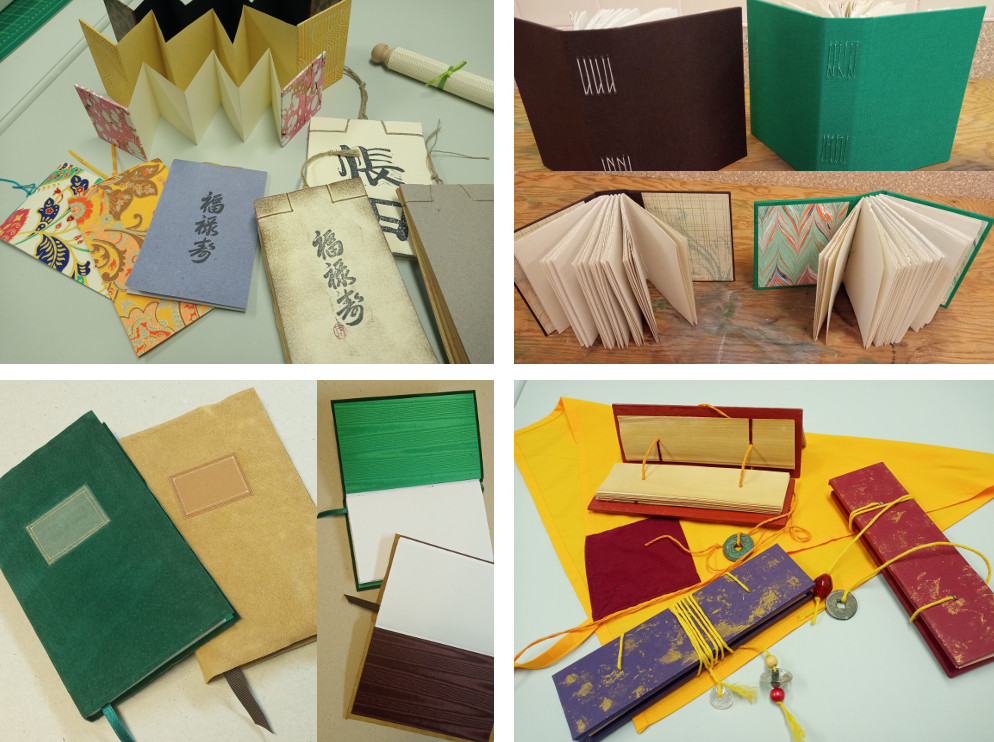
This time around we started in China, of course, since books and paper were invented in China. In the second class, we made palm leaf books, a structure that probably originated in India. Next we did one of the many Italian longstitch techniques, and then we jumped to USA and made some books in the style of the Roycrofters.

Thursday, April 23, 2020

Zhen Xian Bao on screen

I have written here previously about Chinese Thread Books, or Zhen Xian Bao. Of course, most of us learned about these wonderful folded books via Ruth Smith's research, which she published in A Little Known Chinese Folk Art: Zhen Xian Bao in 2012. It's an obscure Chinese folk art from a specific region of rural China, now popular with a niche group of folks who are interested in folded books.

Imagine my surprise, as my daughter and I were watching a movie at home this evening, and a Chinese Thread Book appeared on screen.

So, although Dolittle didn't quite become the smash hit they were likely hoping for, I am now a fan of this movie because they used a Chinese Thread Book as a prop! A nice little surprise in these quarantine times. Here are a couple of screen captures from the movie. These few glimpses occur between 1:10:50 and 1:11:00.


I have made a few of these over the past few years and you can see some pictures if you want to scroll through earlier blog posts. But more exciting, I acquired a real one a couple years ago. So, here are a couple photos of the real one that I have:


I mean, really it doesn't make much sense for Dr. Dolittle to have a Chinese Thread Book given where they originate and what they were typically used for. It does look nice on his desk, though.

If you're interested in learning more about these books and their Chinese origins, Ruth Smith has written a book of instructions as well as a book about the history. I believe you can purchase from her directly if you contact her through Instagram, username: foldedsecrets

Also, I hope you've had a great World Book Day!
Tuesday, July 19, 2016

Chinese Thread Book Workshop

Next month I will be conducting a workshop about the Chinese Thread Book, also called Zhen Xian Bao. The workshop will be at The Morgan Conservatory in Cleveland, Ohio and there is still time to register if you want to join me. August 13 and 14.

The Chinese Thread book is part of a rather obscure Chinese folk art tradition that was practiced in some rural areas of China, and may still be found if you look carefully. Women used these books primarily to keep their sewing supplies (threads, needles, patterns, swatches, etc), and any other bits of paper, photographs, etc that needed saving. My work on these is based on the information collected by Ruth Smith, who introduced the world to this dying craft after she did primary research on these folded books while visiting China. Smith identified a number of variations on the thread book structure and with quite a lot of variation in the number of boxes. This is one that I made, shown here in a video to give you an idea of how it works.


I have made a number of these in different sizes and using different structures. In the workshop, we'll be making one similar to the one in the video and we will look at traditional decorations and spend some time adorning our thread books appropriately.


For the workshop we will have a variety of Chinese fabrics and interesting papers to use. I have also seen photos of authentic Zhen Xian Bao that use things like old coins as decoration, so I also have a batch of old Chinese coins for the workshop participants to use if an authentic look is desired. Workshop registration can be done online at The Morgan Conservatory.

Sunday, September 20, 2015

Book #263

Multi-fascicle Chinese Binding

Today's book is another Chinese binding. As I mentioned yesterday, the paper twist binding was often used as a temporary binding and one situation that required temporary bindings, was when a written text was divided into multiple sections, or fascicles. Each fascicle could be bound using a paper twist binding until all the sections were ready. My example is made from four sections, each bound separately with a paper twist binding. The beginning of each section is marked with a small piece of yellow paper. The fascicles are stacked and bound together using a traditional Chinese stab binding. Chinese books with soft paper covers were stored lying flat on the shelf, in stacks, so the title of the text was often written on the edge of the textblock so it could be read more easily on the shelf.

Saturday, September 19, 2015

Book #262

Paper Twist binding

This is another Chinese binding today, a paper twist binding or chih-nien. This paper twist binding was usually used as a temporary binding; however, some of these temporary bindings did remain in this state permanently.

Friday, September 18, 2015

Book #261

Wrapped-back binding

Today's book is a Chinese binding called pao-pei chuang, or the wrapped-back binding, which is a binding style that evolved from the butterfly binding. These bindings are Chinese in origin, although if you are interested in exploring them further, the most accessible resource is Ikegami's book, "Japanese Bookbinding."

Monday, August 31, 2015

Book #243

Zhen Xian Bao, Pattern Book

I have made another Zhen Xian Bao (Chinese Thread Book) for today. This one is quite different than the first one that I showed (Book 204). This one has added pages and is bound along the spine using a typical 5-hole stab sewing, reinforced with a split dowel. Ruth Smith refers to this type of Zhen Xian Bao as a Pattern Book. There are eight folded pages in this book and they would be used as large pockets to hold patterns or other pieces of paper or fabric that are too big for the little boxes. The centre spread is built up with layers of boxes similar to the first book that I showed. Traditionally, the pages and all the boxes were elaborately and colourfully hand decorated with flowers and geometric patterns. Including the eight folded page pockets, this Zhen Xian Bao has 34 compartments.

Sunday, August 02, 2015

Book #214

Sempūyō

Another Japanese binding today. This is the sempūyō binidng, or Flutter Book. Like most Japanese bindings, this structure was originally Chinese. This one remained more popular in China than in Japan. The pages form an accordion, again not made from one long sheet but rather from a series of folded sheets that have been adhered at the peak of each mountain. The cover wraps around the spine of the book, but leaves the spine free to flutter open. The cover of this example is a sheet of Moriki Kozo, which is super lovely paper if you ever have a chance to work with it.

Thursday, July 23, 2015

Book #204

Zhen Xian Bao

Today's book is a Chinese Thread Book, or Zhen Xian Bao. This is an obscure Chinese folk art that was practiced in some rural areas of China, and may still be found if you look carefully. Women used these books primarily to keep their sewing supplies (threads, needles, patterns, swatches, etc), and any other bits of paper, photographs, etc that needed saving. I have made this one based on the information collected by Ruth Smith, who introduced the world to this dying craft after she did primary research on these folded books in China. This is one way that they were made and my example has fifteen boxes. Smith identified many variations on the thread book; some with different structures and with quite a lot of variation in the number of boxes.

If you are interested, I made this little video to demonstrate how all the compartments open. I even have some random snippets tucked away in there.


Monday, June 22, 2015

Book #173

Chinese Stab Binding

This is a copy of POW! by Mo Yan that I bound in a traditional Chinese format in four parts, for the Nobel Museum bookbinding exhibition in Sweden this year, recognizing Mo Yan's Nobel prize for literature.

Saturday, April 04, 2015

Book #94

Chinese Bamboo Binding

I have attempted to create something similar to a Chinese bamboo book, which is sometimes called the Chinese Pothi binding since it is believed to be an adaptation of the Indian Pothi (palm leaf) binding. Books like these were the very earliest bound manuscripts in China and were made from split bamboo strips and bound together with leather or silk. In Chinese it is called wei pien when bound with leather or sze pien when bound with silk.

Tuesday, March 03, 2015

Book #62

Dragon Scale Binding

Since I was talking about scrolls, I decided to try making a Dragon Scale scroll. There is very little information about this type of Chinese binding and I have never seen any instructions or ever seen a scroll like it, in real life. Just a few tidbits of information and a couple pictures scattered about the ether. Consequently, this is probably over simplified and I am certain that my attempt is not an impressive imitation, but it is what I came up with given the lack of resources. It is a multi-page scroll and each page is a different length. I have used strips of images on the edge of each sheet to emphasize that. The pages are bound together on a rod so they can be rolled up like a scroll. A proper example would likely have many more pages and as you can see, the pages will tend to curl up when the scroll is opened, suggestive of dragon scales. I believe this kind of scroll is also called a whirlwind binding.